0845 680 0312
 Email
0845 680 0312
Email
Email
0845 680 0312
Email
The delivery price is calculated during checkout based on your location and the goods ordered. Our basic delivery prices are:
Delivery within United Kingdom: £12.00 +VAT
Delivery Service: Next working day*
* For products that are in stock and the order received by midday.
Some products go through a final configuration and calibration before being shipped. If the calibration labs are busy this can add up to two days on to the delivery schedule but guarantees a fresh calibration.
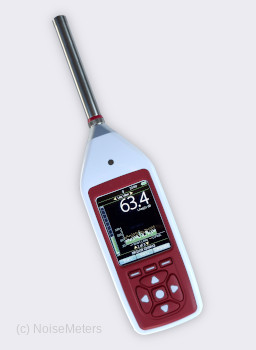
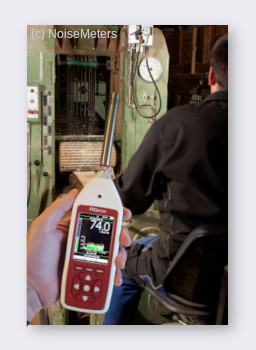
The Optimus Industrial sound level meter is for measuring sound levels in factories and other work environments in line with the UK and EU occupational noise regulations.
Let the meter take the strain - The Optimus Industrial has been designed specifically for occupational noise measurements. Rather than being a general purpose meter that leaves you trying to select the correct measurement range and parameters, the Optimus Industrial does it all for you, recording all the measurements that you might need now and in the future.
Lower cost meters are available, but they may not meet the IEC 61672 standards demanded by the regulations and may not be Integrating as required for occupational noise measurements. They will certainly not be so powerful or easy to use.
The noise at work regulations state that you should use at least a Class 2 Integrating Sound Level Meter that provides you with measurements of LAeq and LCPeak. The meter should be verified by a suitably equipped laboratory when new and at least every two years. You also need a Calibrator to check the meter's function before and after making measurements.
For occupational noise measurements with noise exposure calculation we recommend the Noise Measurement Kit CK162B. This includes everything you need for a full occupational noise survey.
Where the noise levels are particularly high, we recommend Optimus Industrial with Octave Band Filters, which gives the ability to assess the level at the ear when wearing different hearing protectors. See the Optimus with Octave Band Filters page for more information.
Optimus sound level meters can be supplied alone or as part of a noise measurement kit.
If your application does not require the use of a calibrator, or if you already have a suitable calibrator then the sound level meter can be bought on its own. In this case you will receive the sound level meter, windshield, NoiseTools software and calibration certificate.
However, most regulations state that you should use a sound level calibrator to check the function of the sound level meter before and after making noise measurements.
The "Noise Measurement Kits" listed on this page include everything you need for most applications. The order code for a kit begins with "CK" and includes:
The Optimus Industrial Sound Level Meter measures all the parameters that are needed for an occupational noise survey. What's more, it measures them all at the same time, so there is no need to work out which measurements you need before starting.
)
It measures all parameters at the same time in a single measurement span:
The meter stores the measurements for download to a computer:
The meter's display shows the main parameters that are needed when making noise at work measurements: LAeq or Lavg (average sound level), LPeak (maximum peak level) and the current sound level. With a button push or two, it can also show more detail, such as Dose %, LEPd, exposure, memory and calibration status.
The bar on the left of the display shows the current level, changing to yellow and then red when the sound level goes above the defined action levels (usually 80dBA and 85 dBA).
Although the display shows only the commonly used parameters (LAeq, Peak, etc), this data logging meter stores the sound levels for all time and frequency weightings, along with a time history for the more common ones.
Summary - These "overall" values describe the noise for the whole measurement period. They include the Max and Min values for all frequency and time weightings, along with the all important Leq (A, C and Z weighted) Lavg, and Peak (C and Z weighted).
Time History - The meter can be set to store time history measurements at one of a number of rates between 10 ms and 2 seconds. It stores the Leq (A, C and Z) and the Peak (C and Z), giving a very informative graph of the noise over time. This is particularly useful when monitoring for long periods.
An easy and reliable way of making on-site notes with your noise measurements. Make a brief recording (either your voice or the actual noise) just before taking a measurement.
Before starting a measurement, the meter will ask if you want to record a "Voice Tag". The meter will record any speech or the noise in question (to help you identify it later) for up to 30 seconds. This audio is transferred to the software automatically along with the measurement.
The Optimus Industrial was designed specifically for noise at work measurements in line with the UK and EU regulations. It provides all the noise measurement parameters that you need in a meter of the correct grade.
This meter can be used without a computer, manually noting down the important parameters, such as Leq, Lavg and Lpeak. However, it stores all the measurements for download to the NoiseTools software, which is included.
The overall process for making noise at work measurements consists of:

Most regulations and guidelines state that the meter's calibration should be checked before making measurements, and that you should keep records of these calibration checks.
Fit the Calibrator over the microphone as shown, switch it on and press the Calibrate button. The meter will automatically make any adjustments.
Calibration details are stored in the meter so that you can either make note or download them to a computer for inclusion in noise reports.
To start a measurement, simply press the Start key, shown on the right. This process is the same for any model of this meter, whether you have data logging or not.
The meter will start measuring the LAeq and LCPeak (the main parameters needed for Noise at Work), along with a few other useful parameters.
When you are happy that you have measured for long enough (the LAeq has settled for example), simply press the Stop key.
The meter will store the overall values for LAeq, Lavg, LCeq, LPeak and a few others. It will also store these parameters every second, or whatever rate the meter is set to. This is all done automatically, there is no need to tell the meter to store them.
Once you have finished making measurements, they can be downloaded to a computer using the NoiseTools software provided.
Many occupational noise regulations recommend a second calibration check, at the end of the measurement process. This ensures the meter's performance hasn't drifted since the start.
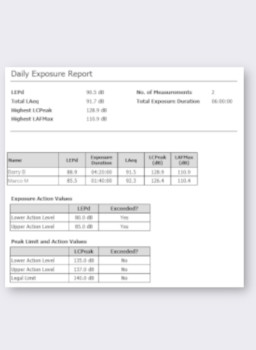
Armed with the Leq, and LCPeak measurements, the final stage is to calculate a worker's actual noise exposure throughout the working day, the LEP,d. This can be done manually or the NoiseTools software can do it for you and produce reports for your records.
The meters on this page include the NoiseTools software - there is no extra charge for this. You can download the software to evaluate it before making a purchase.
The NoiseTools software runs on a Windows PC. It is compatible with all recent versions of Windows, from Windows 7 onwards.
There are not too many options for the Optimus Industrial sound level meter, as even the basic model includes all the parameters that you need for occupational noise measurements in line with the regulations. Additional features, such as octave band filters, can be fitted in future, so you can decide later if you are unsure right now.
The main options are:
The most important of the accessories is the Calibrator. The regulations state that you should use one to check the function of the meter before and after making any measurements.
The Noise Measurement Kits, order codes CK162B and CK161B, include a sound level meter, calibrator of the correct class, windshield, software, carrying case and download cable.
A Class 1 sound level meter is a little more accurate than a Class 2 model. It is also more expensive. If you are using the meter exclusively for occupational noise measurements then the regulations are quite clear: Class 2 is adequate. For this reason we recommend the Class 2 model.
However, if you need to make other noise measurements, such as noise emitting from your factory into the local environment, then it might be wise to go for a Class 1 meter. In these instances the local authority (Environmental Health Officer for example) will usually expect measurements made with a Class 1 meter.
With this option fitted, the meter splits the spectrum into bands to provide information about the frequency content. Meters with the Octave Band option always have the Data Logging option fitted too.
Octave bands are very useful when monitoring areas with very high noise levels. The octave band measurements are used by the software to calculate the level at the ear when wearing different hearing protectors. This option can be added at a later date without returning the meter.
For this option please visit the Optimus Industrial with Octave Band Filters page.
| Standards | IEC 61672-1:2013 Class 1 or Class 2 |
| IEC 61672-1:2002 Class 1 or Class 2 Group X | |
| IEC 60651:2001 Type 1 I or Type 2 I | |
| IEC 60804:2000 Type 1 or Type 2 | |
| IEC 61252:1993 personal sound exposure meters | |
| ANSI S1.4 -1983 (R2006), ANSI S1.43 - 1997 (R2007), ANSI S1.25:1991 | |
| IEC 61260:1996 & ANSI S1.11-2004 | |
| DIN 45657:2005-03 | |
| Measurement Range | 20dB to 140dB RMS single range |
| Noise floor | <18dB(A) Class 1, <21dB(A) Class 2 |
| Frequency weightings | RMS & peak : A, C, & Z measured simultaneously |
| Time weightings | Fast, Slow & Impulse measured simultaneously |
| Memory | 8GB, 32GB factory fit option |
| Time history data rates | 10ms, 62.5ms, 125ms, 250ms, 1/2 sec, 1 sec or 2 sec |
| VoiceTag | Up to 30 seconds of audio notes with each measurement |
| Integrators | Three simultaneous “virtual” noise meters. Integrator 1 is preset to Q3 for Leq functions. Integrators 2 & 3 can be configured with the following |
| Exchange rate | 3, 4 or 5 dB |
| Threshold | 70dB to 120dB (1 dB steps) |
| Time weighting | None or Slow |
| Criterion level | 70dB to 120dB (1 dB steps) |
| Criterion time | 1 to 12 hours in 1 hour steps |
| Integrator quick settings | EU, OSHA HC & OSHA NC, OSHA HC & ACGIH, MSHA HC & MSHA EC, Custom |
| Size | 283mm x 65mm x 30mm |
| Weight | 300gms/10oz |
| Power | 4 x AA alkaline |
| Typically 12 hours with alkaline AA | |
| Typically 20 hours with lithium AA non-rechargeable | |
| External power: 5v-15v via MultiIO socket via ZL:171 cable (2.1mm socket) | |
| Outputs | USB Type B to PC |
| AC & DC output via ZL:174 (2 x Phono, 1m) | |
| Multi-pin IO for external power via ZL:171 cable (2.1mm socket) | |
| Bluetooth BLE compatible with Anrdoid and iOS devices | |
| Case | Material: high impact ABS-PC with soft touch back and keypad |
| Tripod mount | 1/4" Whitworth socket |
| Environmental | Temperature: Operating -10°C to +50°C, storage -20°C to +60°C |
| Humidity: Up to 95% RH non-condensing | |
| Electromagnetic performance | IEC 61672-1:2002, IEC 61672-2:2003, IEC 61672-1:2013 & IEC 61672-2:2013 |
| Except where modified by EN 61000-6-1:2007 & EN 61000-6-1:2007 | |
| Language Options | English, French, German, Spanish, Italian |
| Display functions | LXY, LXYMax, LXYMin, LXeq, LCPeak, LZPeak, LCeq-LAeq, LXE |
| Graph of short LAeq, LCPeak, TWA, dose%, est dose% | |
| Measurement run time | |
| Stored functions | LXYMax & time history of LXYMax |
| LAeq, LCeq, LZeq, LCPeak, LZPeak, LAPeak, Lavg, TWA. %dose | |
| Time history of LAeq, LCeq, LZeq, LCPeak, LZPeak, LAPeak, LAIeq, Lavg | |
| where x=A ,C ,Z; y= F, S, I |
 Basket
)