0845 680 0312
 Email
0845 680 0312
Email
Email
0845 680 0312
Email
A sound level meter fitted with Octave Band Filters has the ability to split the audible spectrum into smaller bands, identifying the frequency content of the noise. To help explain why Octave Band Filters are sometimes used, first have a look at a simple noise measurement.
Most simple noise measurements are made using the "A" frequency weighting and the results expressed in dB(A). When a measurement is "A" weighted the sound level meter is responding in a similar way to the human ear, being more "deaf" at the lower and higher frequencies.
The image shows the A weighting filter response, removing much of the lower (deep tones) and some of the higher frequency (high pitch) noises.
The "A" weighting filter isn't a particularly accurate representation of the human ear, but as it is defined by standards that most sound level meters follow, it means results from different meters can be compared.

When you need a little more information than this, you split the spectrum into about 10 bands. These are called the Octave Bands because there is one octave between the bottom and top of each band. The centre frequencies for these bands are usually:
31.5Hz , 63Hz , 125Hz , 250Hz , 500Hz , 1kHz , 2kHz , 4kHz , 8kHz and 16kHz
The sound level meter will measure the noise in each of the octave bands, either all at the same time (real-time or parallel filters) or switching to one band at a time (serial filters).
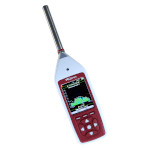
This image shows a typical octave band spectrum. In this case you can clearly see that the 1kHz and 2kHz bands are showing much higher levels than the others. If you were trying to reduce the noise then based on this measurement you can see where all the effort needs to go, especially when you consider that these bands coincide with the frequencies where the human ear is most sensitive.

1/3 Octave Band Filters are very similar in nature to the Octave Band filters described above. The difference is that each of the Octave Bands is split into three, giving a more detailed description of the frequency content of the noise.
Although rarely used for occupational noise measurement, 1/3 octaves are useful in many environmental, building acoustics and noise control applications.

The answer to this question comes down to the nature of the noise you are measuring and to the size of your budget.
The sound level meter measures in all the bands at the same time. In the past this one done with multiple filters but now it tends to be done using Digital Signal Processing techniques. The advantage of real-time octave band filters is that measurements can be made quickly and none of the bands miss any of the noise during the measurement period.
The sound level meter measures in one band at a time. The meter will usually be fitted with a single filter circuit, which will be electronically switched to measure the different bands. With most modern meters you can set the filters to scan through from 31.5Hz to 16kHz automatically. The advantage of serial octave band filters is that the meter has only one filter circuit, keeping the cost and power consumption down.
These filters can be used for many applications, but in particular they are clearly used to identify the frequency content of the noise and to help you to control and reduce the noise. Here are some examples:
 Basket